
 |
EN  |
|
|
|
Foresight
The world is not chaotic – it only appears chaotic to the uninformed mind
Inflation, recession, war in Europe, political division in society, excessive bureaucracy, deteriorating legal certainty, green overregulation, the shift of the global economy to the BRICS+ countries, replacement of US treasuries with gold reserves, global trade wars, exponential technologies, automation through artificial intelligence and robotics resulting in massive job loss, Chinese AI outperforming the west.
These are all the symptoms of the changing world order – from the Western-dominated "rules-based" order toward a multipolar world with a strong center in Asia, with China having once again emerged as a world power.
Empires rise and fall in repeating cycles. The upcoming changes are therefore to a certain extent foreseeable and can be acted upon accordingly.
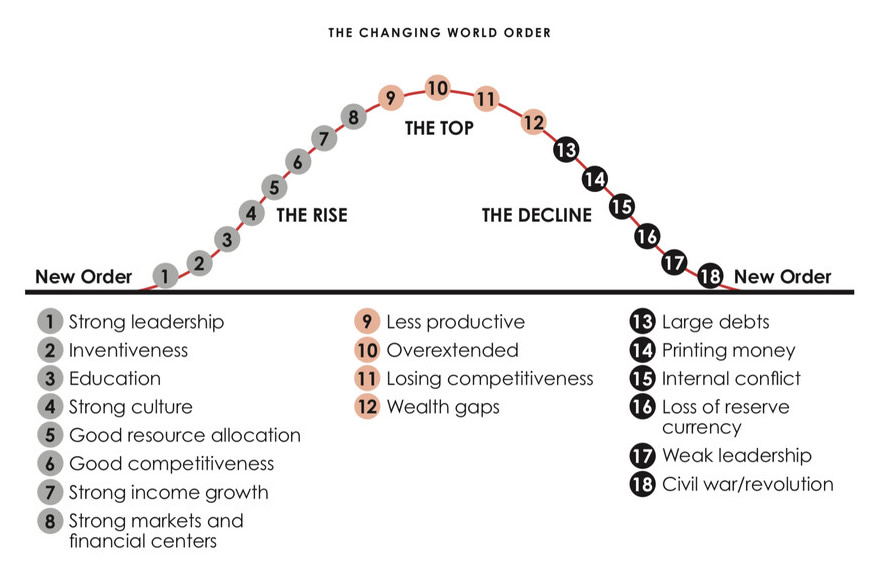
The cycle describing the rise and fall of empires
Source: Ray Dalio
A great source of insight for understanding these cycles is investment legend Ray Dalio. In this 43 minutes video he describes the underlying mechanisms and the coming changes – the downfall of the West, first gradually and then suddenly, and the rise of Asia.
Principles for Dealing with the Changing World Order by Ray Dalio
Source: https://www.youtube.com/watch?v=xguam0TKMw8
Our approach
Below we have outlined the major macro trends we consider future-deciding and illustrate why an appropriate exposure in these areas will be key for a future proof strategy.
Longevity & regenerative technologies 
Exponential technology powered by AI
Technology is on an exponential trajectory
The most interesting macro trend of our time is technology. In the roughly 55 years since the introduction of the first commercial microprocessor by Intel in 1971, technology has changed every aspect of our lives in ways which were previously unthinkable.
Technology is self-reinforcing: Technology allows to create more technology based on the existing technology. This makes technology self-accelerating, leading to the exponential growth trajectory we see today. We have already entered the age of AI where technology can create new technology even without human help. AI creates stronger AI by itself.
In a few years, we will see the transition from classical transistor-based computing to quantum computing – a change in the entire foundation of computing that will pave the way for artificial generalized intelligence (AGI), i.e. true strong AI.
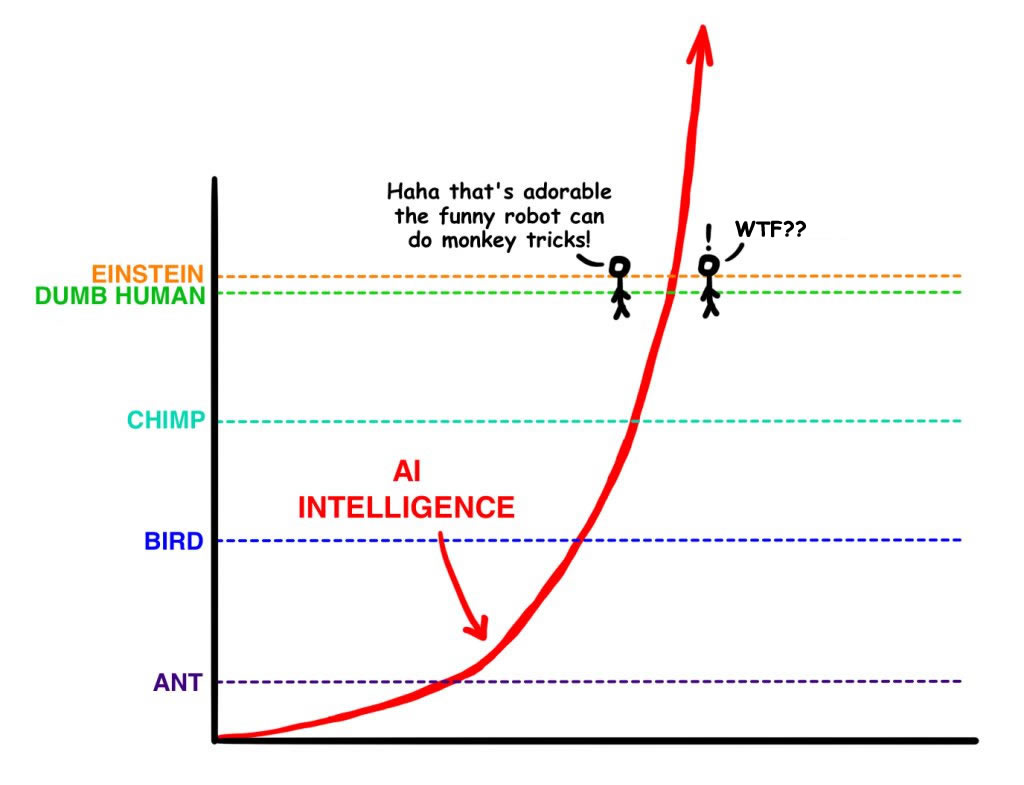
The emergence of AGI, expected around 2029-2035
Source: https://waitbutwhy.com/2015/01/artificial-intelligence-revolution-1.html
Exponential trajectories are not well managed by humans, because of our innate cognitive bias to expect the future to behave like the past.

The human bias for linear development
Source: https://waitbutwhy.com/2015/01/artificial-intelligence-revolution-1.html
Technology adoption rates offer an illustrative reflection of the underlying exponential nature. ChatGPT is the service with the fastest adoption rate ever seen to date in the technology sector (and that was introduced by a new player without existing user base).
It took 5 days to reach 1 million users and then grew to 100 million users within 2 months.
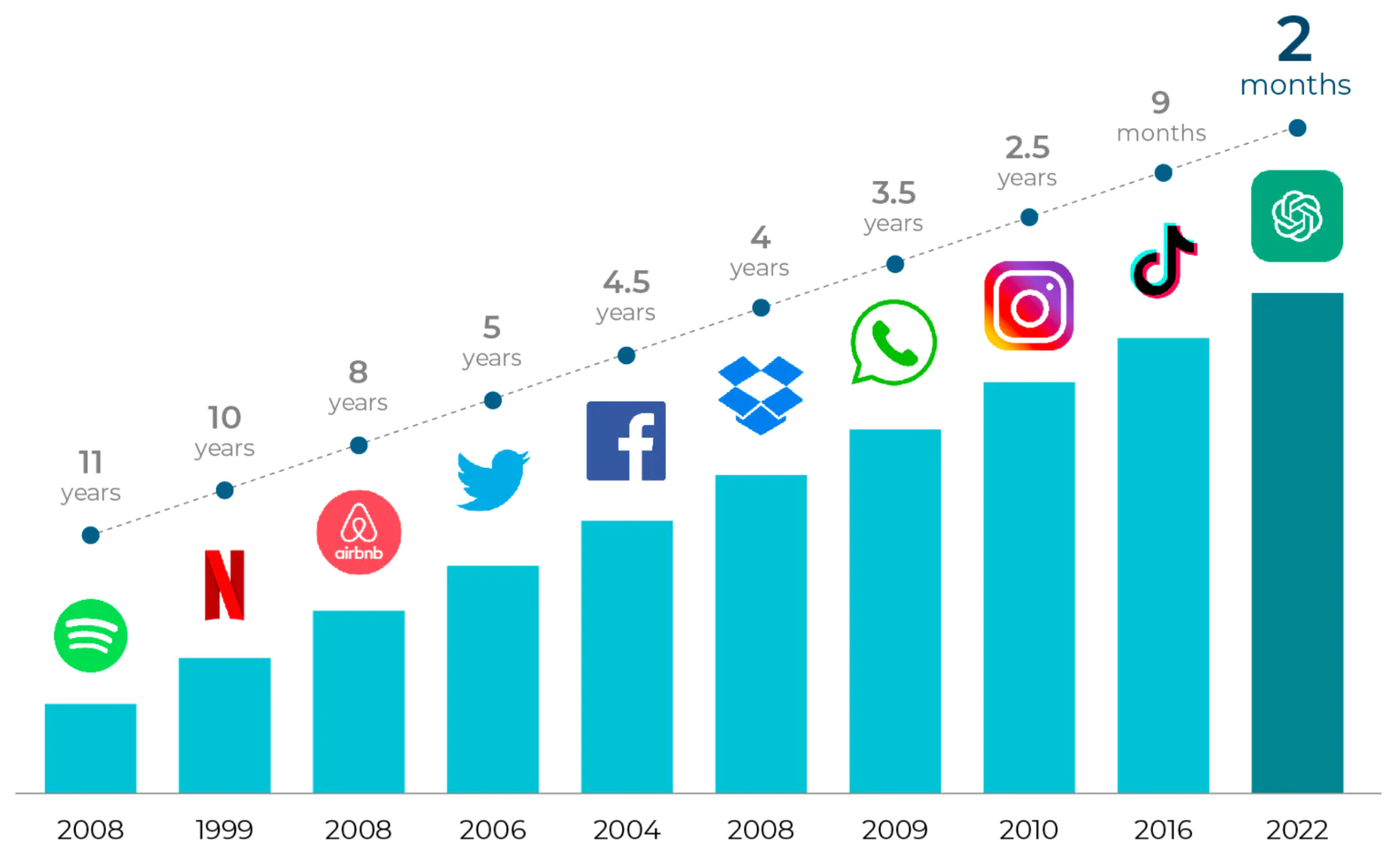
The time it took technology services to reach 100 million users
Source: https://bluesoft.com/blog/bluesoft-large-language-model
The two most important companies to watch in the AI sector are Tesla, with full self-driving capacities and the rollout out of humanoid robots for all areas of life and work, and SpaceX with the Grok AI initiative, own data centers (also in space), and own chip production in the US. Elon Musk is focusing on robots, as they can prepare the territory for colonization of other planets, a.k.a. Mars, without risking human lives in the process. The launch of commercial household robots is a major step to create such robots, improve the technology IRL and introduce a product for the masses to make the longer term goals financially viable.
The third key player in the AI race is China. China has made significant strides through a centralized, state-driven strategy that emphasizes rapid deployment and integration of AI across industries. The Chinese economy has hence undergone massive technological advancements in recent years and now produces own chips independently of Taiwan, better AI technology than ChatGPT, and better weapons technology than the West. China is already living in the future, while the West basically only has Elon.
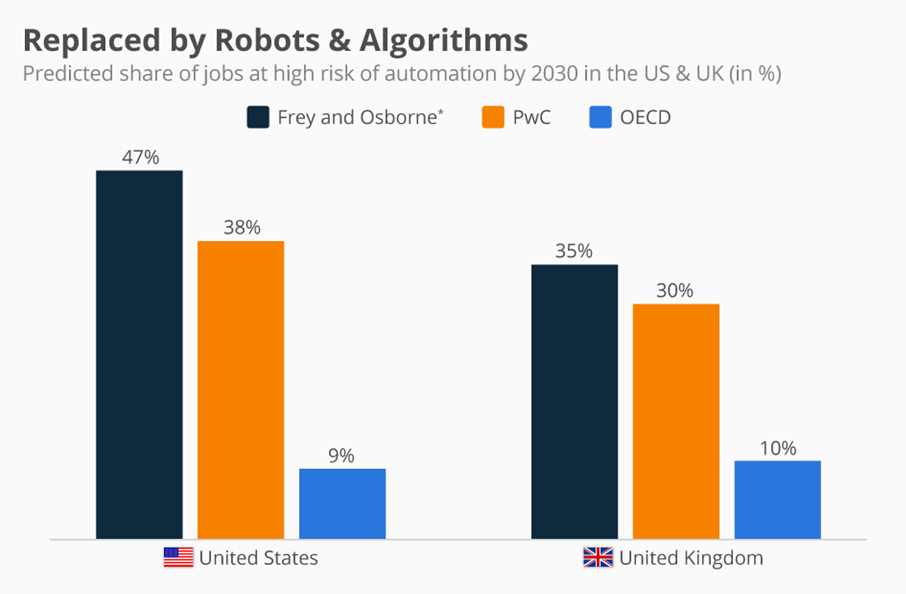
OECD ignorance towards job losses through automation
Source: https://www.statista.com/chart/11370/share-of-jobs-at-high-risk-of-automation-by-early-2030-in-us-uk
With the help of automation, AI tools and blockchain technology, machines are able to create entirely new markets and ecosystems, and trade with each other. In the medium term, they will outnumber and outperform humans in every conceivable task.
This will lead to a massive job loss, most accentuated in the Western hemisphere. The implications are already being felt today. The estimates range up to 400 million workers displaced globally by 2030. More recent estimates suggest that this figure will be much higher, with corresponding consequences for consumer markets. If machines account for the majority of economic value creation, less income will flow to people. And people without income cannot buy products or services, nor pay taxes.
The trend is largely ignored or downplayed by policy-makers, since there are no solutions available to counter the coming automation – neither regulatory nor financially (i.e. UBI). Western nation states already suffer from over-indebtedness, fiscal pressure, unfundable social security systems, overregulation, a shrinking productive class, and vanishing economic weight. The downfall is inevitable.
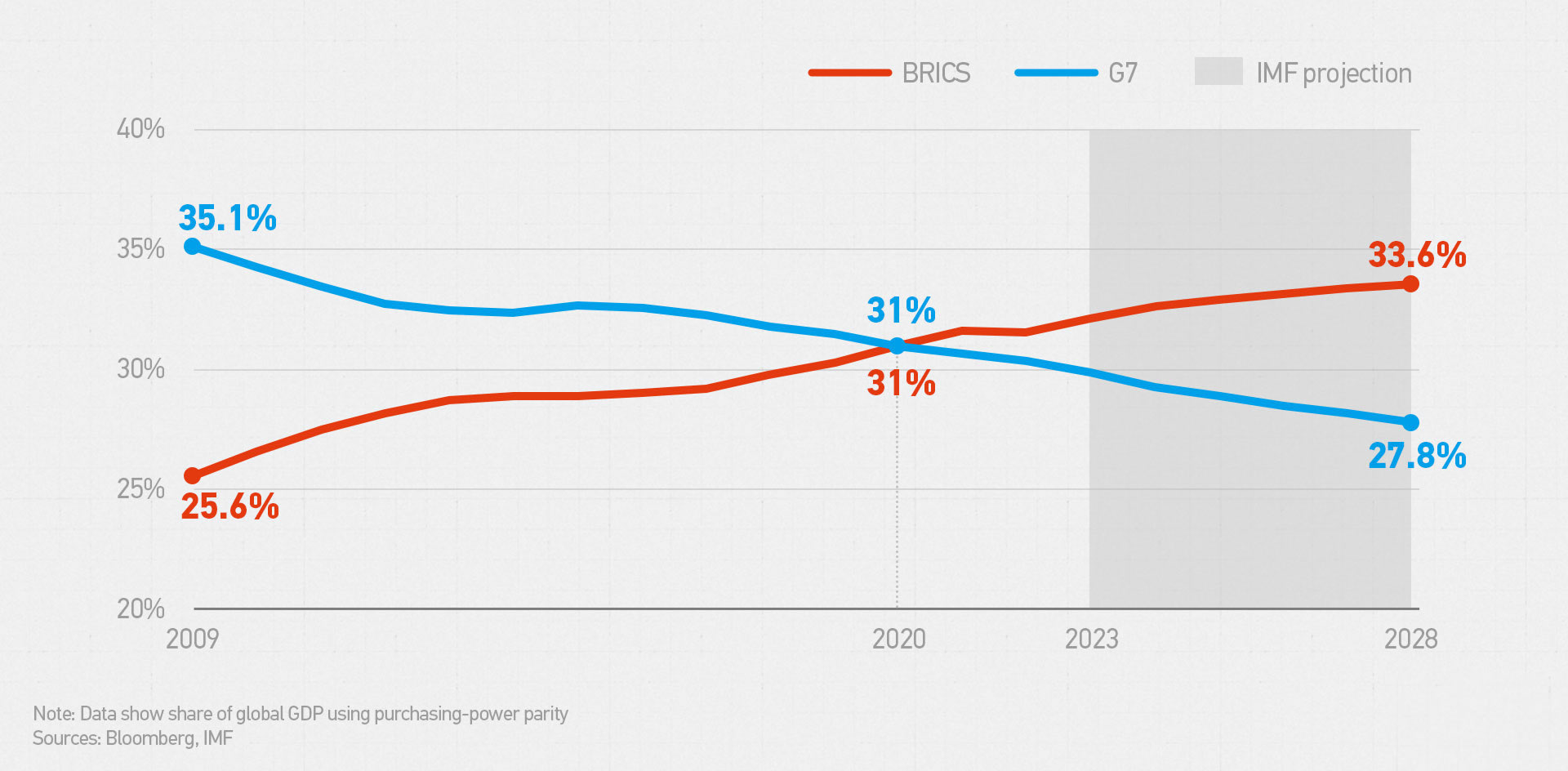
BRICS vs G7 share in global GDP
Sources: Bloomberg, IMF
Sound money
Gold and Bitcoin as a safe bet in a debased fiat world
Most Western countries are heavily indebted and finance themselves by expansion of the money supply ("inflation") – in other words, by printing more money. However, every new dollar or euro reduces the value and thus the purchasing power of the existing dollar or euro.
Gold, on the other hand, cannot be printed. The annual growth in gold reserves through gold mining amounts to only about 1% of total reserves. Meanwhile, the money supply is growing at a rate of about 6-7% per year. It can therefore be assumed that the continuous appreciation of gold relative to printed money will become even more pronounced.
Gold has retained its purchasing power over the last 3'000 years, while currencies without gold backing always lose value over time.
The following chart shows the depreciation of the major currencies relative to gold over the last 100 years:
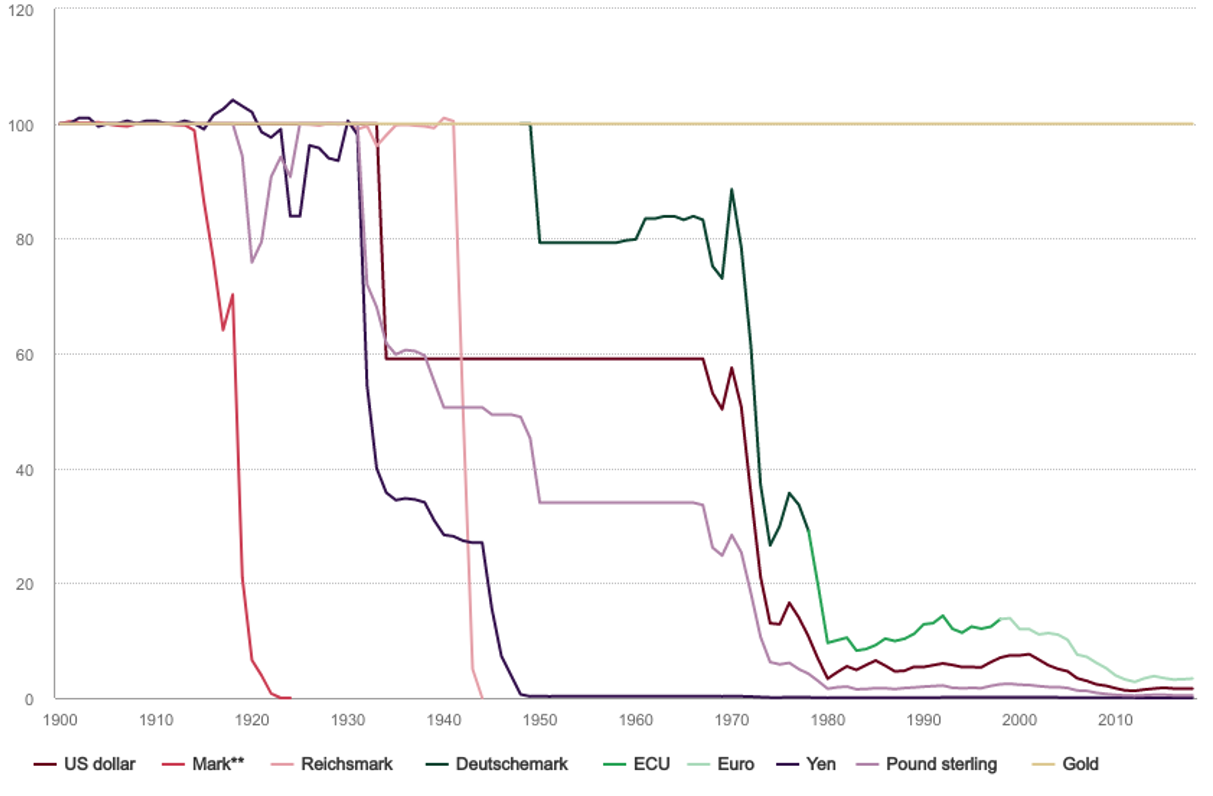
Depreciation of fiat currencies relative to gold
Sources: Bloomberg, Harold Marcuse / UC Santa Barbara, World Gold Council
Gold is the asset of last resort, it always retains value. Gold is considered the most stable and hardest currency in the world. Physical gold bars can be used directly as a means of payment, even without electricity or the internet.
Gold is held by central banks as a reserve asset. Until the financial crisis in 2008, all central banks tended to sell their gold reserves and replace them with US government bonds (US Treasuries, or UST). After the financial crisis of 2008, this trend reversed, and since 2014, the central banks of the BRICS countries in particular have steadily shifted their reserves away from the US dollar by buying gold and selling their US government bonds in return. With the mBridge system the BRICS countries have built an alternative money system independent of SWIFT and US Dollar clearing institutions.
These are direct consequences of American and European sanctions policy and the accompanying decline of the US Dollar's dominance in world trade.
An interesting aspect of the debt crisis issue is the US government's attempt, with the Stablecoin Act, to position the US Dollar as the dominant digital currency and to continue expanding its debt by requiring all dollar-denominated stablecoins to be backed by US Treasuries – essentially replacing BRICS nations as major buyers.
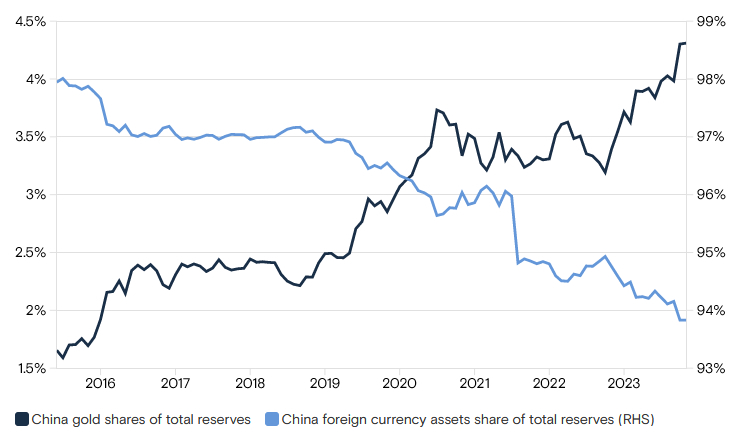
China has largely replaced UST with Gold
Sources: Goldman Sachs Research, Bloomberg, Haver Analytics
Gold performs extremely well in times of crises – in the event of armed conflicts, escalating wars, stock market crashes, global financial crises, and events of force majeure.
Since we are entering a phase of systemic destabilization with the downfall of the West and the rise of a new world order, and a foreseeable escalation into a state of global wars, it can be assumed that the price of gold can no longer be artificially suppressed by US banks.
Similarly, the control over the gold price fixing is currently shifting away from former centers such as the LBMA in London, as trading volumes via Asian gold trading centers, notably the Shanghai exchange, continue to grow.
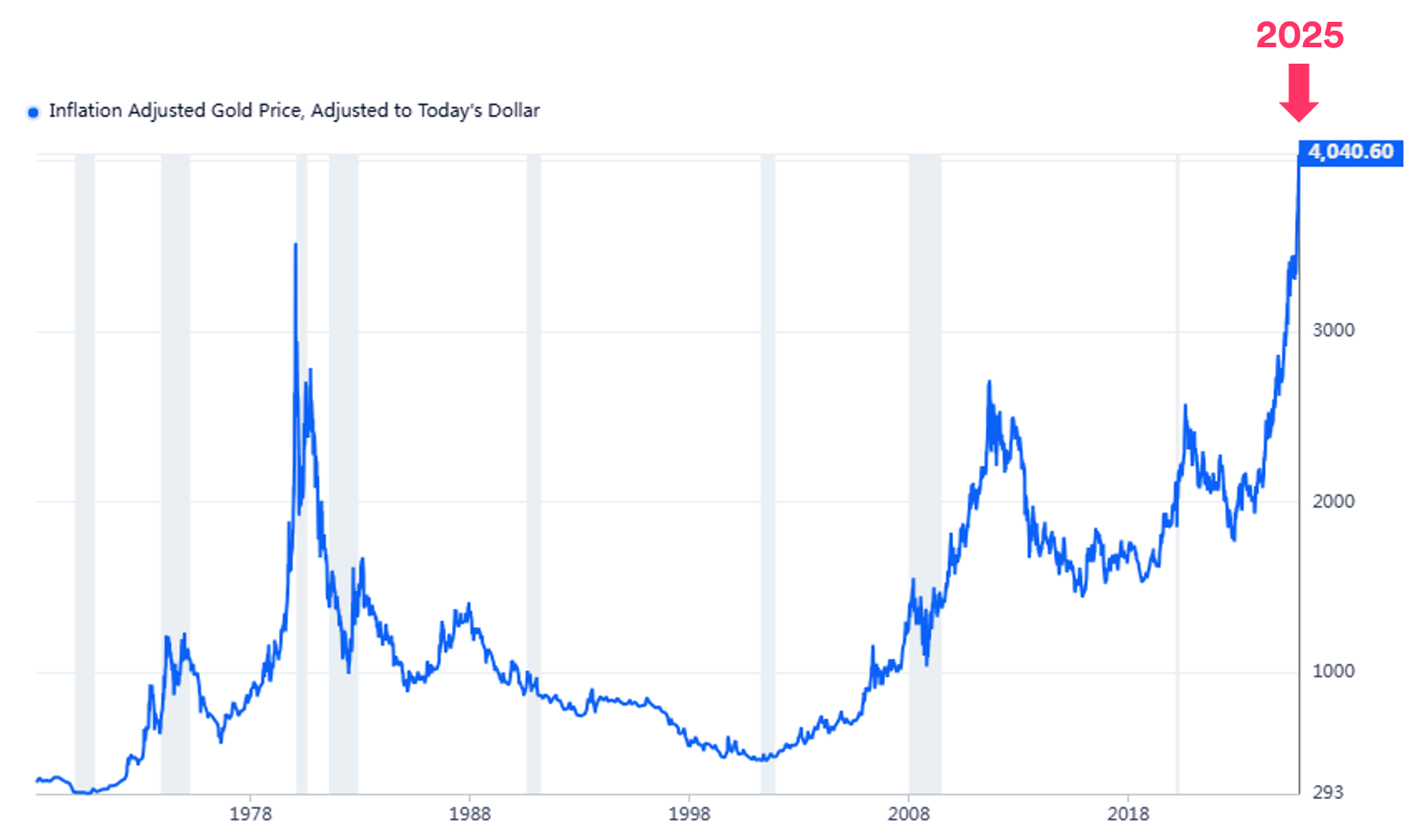
The price for Gold has reached new ATHs in 2025 and beginning of 2026
The other asset, countering global monetary debasement is Bitcoin, as an uncompromisable technical money with a deflationary construction. The amount of Bitcoin cannot be increased beyond the defined supply of 21 million. It is decentralized by nature and removes gatekeepers and direct centralized control in the monetary system. Essentially it realizes a separation of state and money, where money can no longer be weaponized as an instrument of politics.
Also, it offers direct and unassailable property rights for everyone.
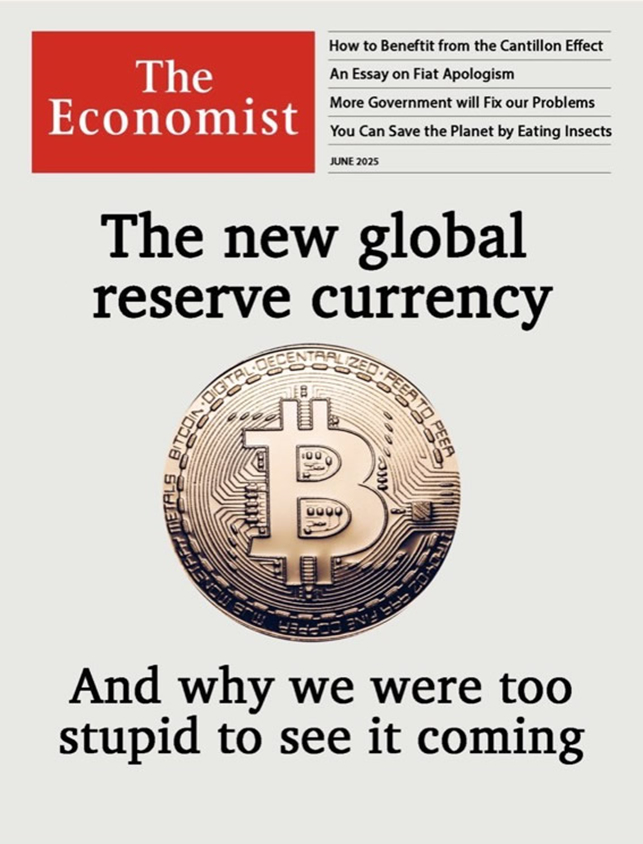
Fake Economist front page, illustrating the state of Bitcoin in 2025
Source: Unknown
Gold and Bitcoin are inversely correlated and thus offer the best hedge for turbulent times when combined.
As an example: On April 13-14, 2024, Iran launched a large-scale air strike on Israel, marking the first direct attack by Iran on Israeli territory from Iranian soil. The attack took place on a weekend when the stock exchanges were closed, so investors were unable to react immediately.
Crypto markets are open 24 hours every day, and the investor reaction was immediate. The PAX Gold Token – a crypto token denominated in gold – traded at a short-term gain of 20% with a 24-hour trading volume of USD 55.63 million. Bitcoin, on the other hand, fell from its then price of USD 67'500 to USD 62'700 within a few hours.
The chart below shows the price development of the two assets:
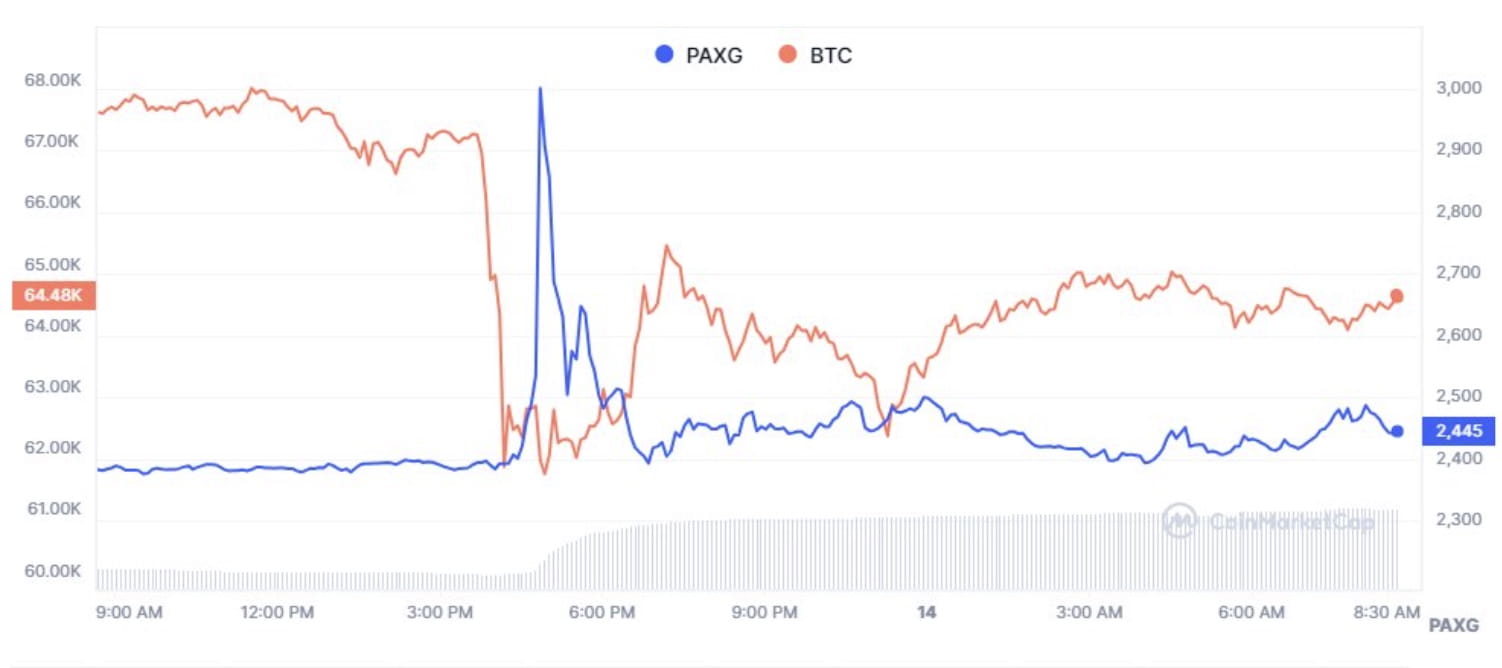
PAXG vs Bitcoin on April 13-14, 2024
Source: https://x.com/BobEUnlimited/status/1779512399420080564
Bitcoin also correlates strongly with technology stocks, especially with the technology-oriented Nasdaq Technology 100 Index. As a technological currency, Bitcoin is traded by investors in a similar way to traditional technology stocks and is influenced by similar macroeconomic forces.
In the meantime, state actors have realized that they cannot defeat Bitcoin itself, so they are attempting to control access to it. Fiat on/off ramps have been heavily regulated and governments have started rolling out their own digital money projects in the form of CBDCs – government-controlled money on the blockchain, with the ability to monitor and programmatically control all transactions and block undesirable ones as needed.
Also, they try to gain control of as much Bitcoin as possible through institutional buying with the help of the world's largest financial institutions, and by creating financial instruments (such as those from Strategy Inc.) to exert control over the price, similar to the gold market.
Bitcoin and gold are both scarce and carry no counterparty risk – they are not simultaneously someone else's liability. It can be reasonably assumed that all unbacked currencies will perform negatively relative to Gold and Bitcoin, not only in terms of value but also in terms of control over the money itself, particularly regarding property rights.
Longevity & regenerative technology
A new growth market
The global population in both the Western world and Asia is ageing. By 2050, more than 2 billion people worldwide will be over 60 years old. This population group represents a large growth market for longevity products and services. Longevity means extending the lifespan as well as the health span, i.e. living as long as possible while remaining healthy.
A number of exponents, such as the entrepreneur Bryan Johnson, point to the potential and possible solutions in this sector to extend the lifespan and health span with products and new regenerative technologies.
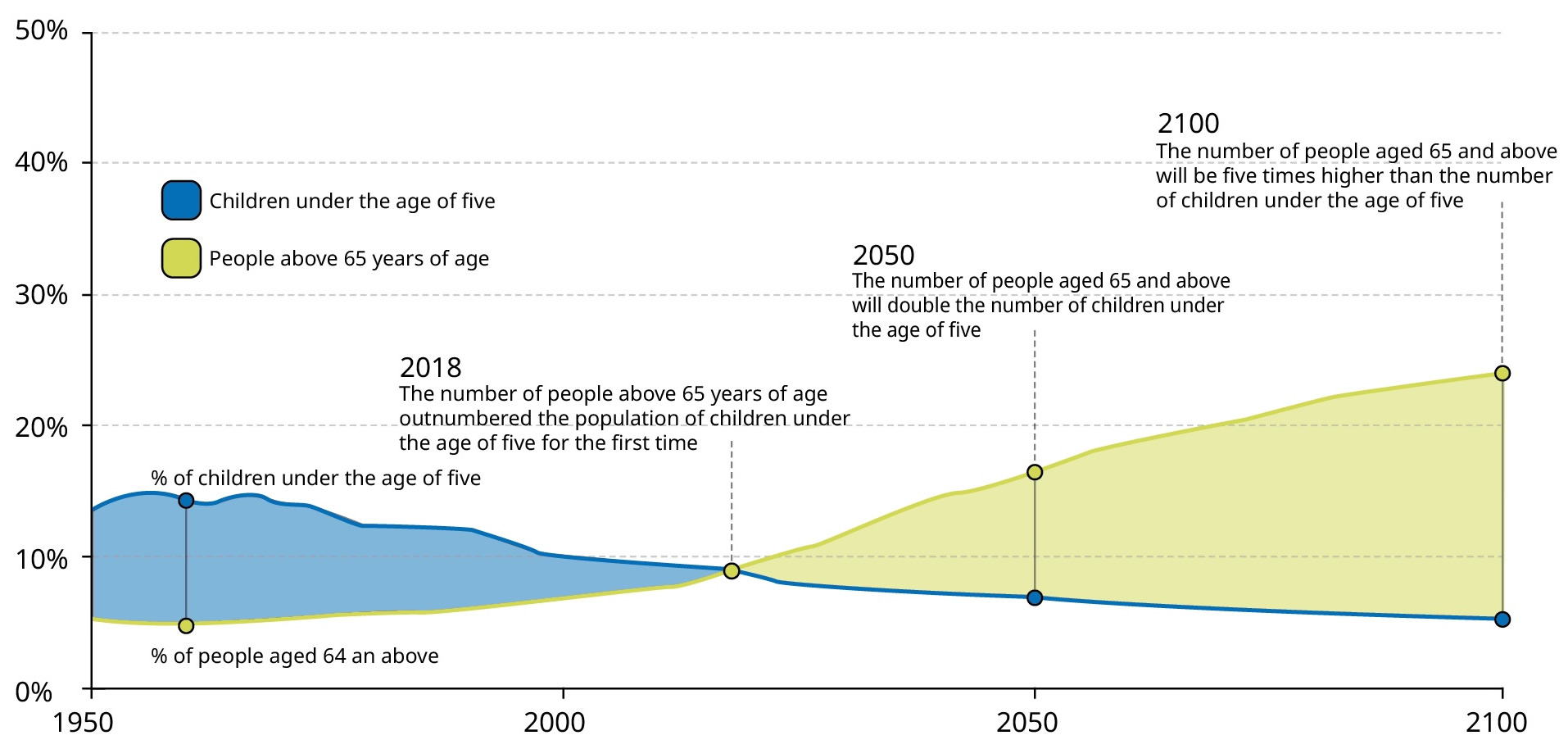
Global aging population projection
Source: https://lausanne.org/report/demographics/global-aging-population
Switzerland as a guarantor of quality
Switzerland is known and sought after worldwide as a location for first-class quality and trustworthy products in the pharmaceutical and medical sector.
Investment opportunities in longevity services, regenerative medical technology, and new classes of personalized supplements in the parapharmaceutical space are poised to benefit from the global trend.
Safe haven destinations
Free private cities, network states and new tax free zones are the safe havens from mismanaged nation states
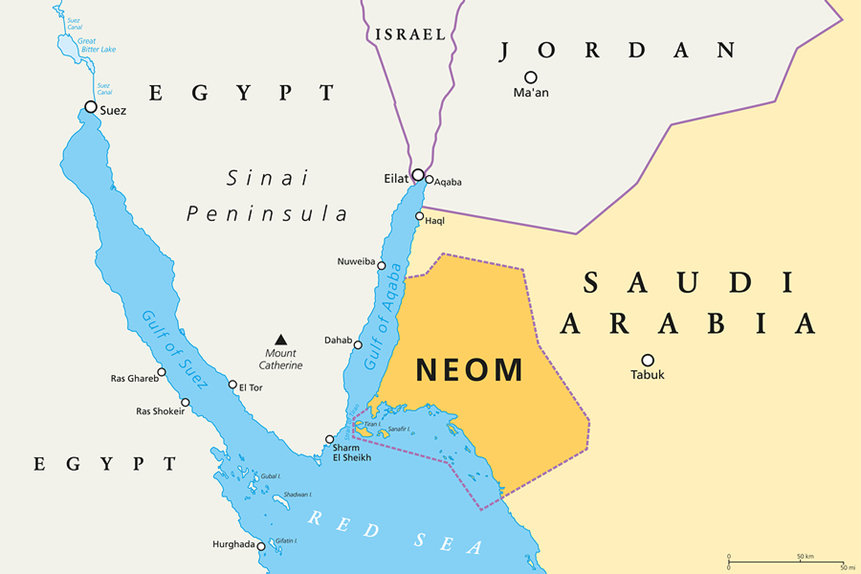
Map depicting the area of NEOM, Saudi Arabia's 500 billion dollar special economic zone, which may be met with skepticism in the short term due to regional conflict
Source: https://www.ubm-development.com/magazin/neom-the-line/
Economic prosperity depends on two main factors:
1. Economic freedom
2. Cost of energy
Economic freedom consists of several components that together influence the individual's freedom, i.e., their options for action or degrees of freedom: property rights, access to a market, free choice of trading partners, a stable currency, and only minimal regulation according to the principle as much as necessary, as little as possible.
People in the most economically free countries earn on average about 6.2 times as much as those in the least free countries. The poverty rate in the least free quarter of countries is about 25 times higher than in the freest countries.
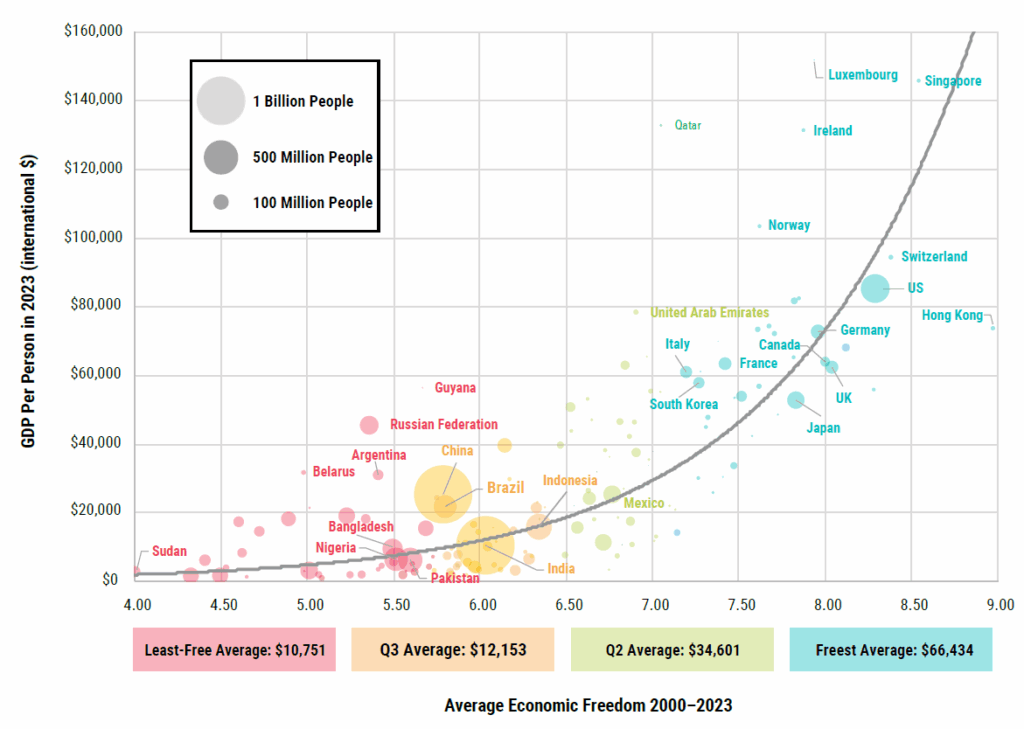
Average economic freedom (2000-2023)
Source: https://denkfabrik-r21.de/wirtschaftliche-freiheit-in-deutschland-sinkt/
It is also noteworthy that countries with more ideological constraints, or no separation between state and religion tend to perform worse. It is not just economic freedom but also the freedom of thought.
In addition to individuals having the opportunity to pursue some form of economic activity that ensures their sustenance, economic activity always requires energy. The cheaper this energy is, the cheaper and more accessible economic activity is for the market players.
The price of energy in an economy depends on access to the relevant energy sources, i.e., the raw materials, and the infrastructure through which access is gained.
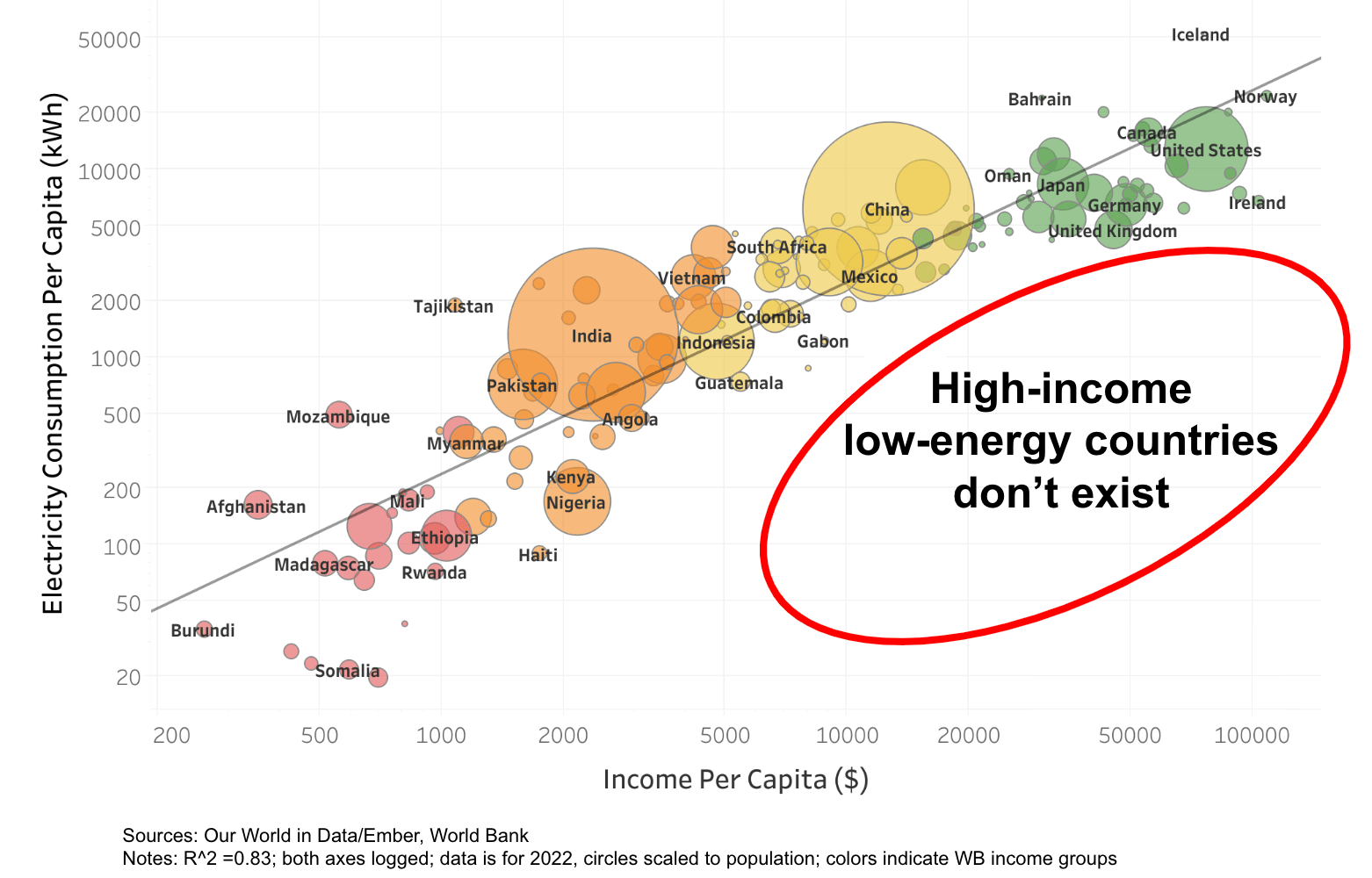
Electricity consumption vs income per capita, log scale (2022)
Source: https://toddmoss.substack.com/p/killer-graphic-shows-why-high-income
Some countries are at a disadvantage compared to others when it comes to access to energy sources. Interestingly, economic freedom almost completely compensates for this through the possibility of developing technology.
Also interesting in this context is Buckminster Fuller's idea that "one in ten thousand of us can make a technological breakthrough capable of supporting all the rest".
Economic freedom makes this possible. In capitalist systems, this leads to a certain degree of inequality between talented and less talented individuals. More socialist-oriented systems try to counter this trend with the introduction of redistribution mechanisms, i.e. regulation. Over time, these lead to ever more redistribution efforts, as the fitter market participants always find ways to prosper despite all obstacles.
Restrictions then tend to grow increasingly severe, while the governing apparatus expands to enforce the rules. In the worst case, an unfriendly elite can seize control of the system, using NGO structures to enrich themselves at the expense of the nation’s wealth.
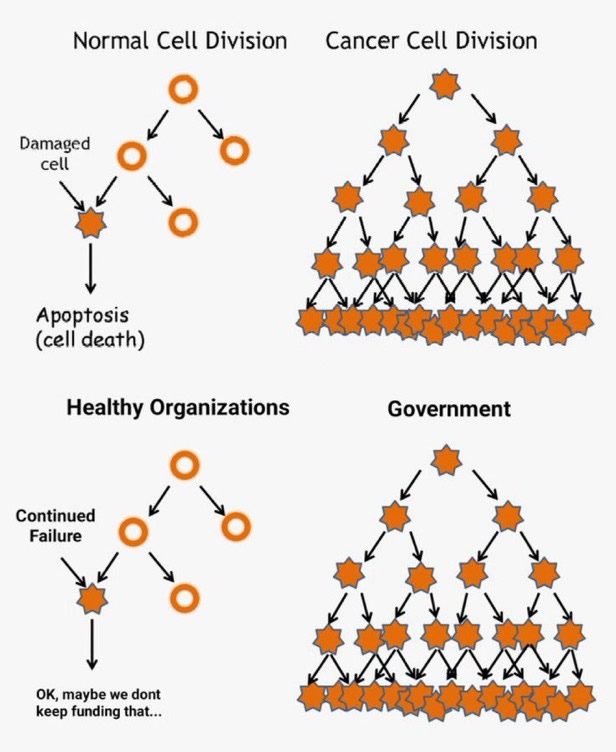
Government programs have no feedback loop for improvement because of their state-mandated monopoly
Source: https://x.com/GodIsVoluntary/status/1986838845669974355
The misallocation of resources through misguided policies of all kinds reduces economic performance and leads to deficits that must be financed through tax increases and money printing. This leads to the over-indebted nation states that we see today, that cannot function sustainably in the longer term. In order to keep these systems alive more and more restrictions will become necessary to suppress internal conflict such as surveillance measures and censorship.
As Dalio described at the beginning, this negative spiral reduces the competitiveness of economies until they collapse under their own weight.
You can go down with the system, but you don't have to. More liberal systems, free private cities, network states and tax free zones are the safe havens from mismanaged nation states.
As a matter of fact, alternative sovereign city states have existed for centuries, but did mostly go unnoticed, as they were only accessible to a selected few – examples being the City of London or the Holy See. Even the United Nations Building in Geneva and the building of the Bank for International Settlements in Basel are tax free and legally inviolable zones.
Today, technology paves the way for new safe havens, accessible to everyone who is interested. The main idea behind free private cities or network states is the voluntary association based on common interests, not place of birth. Their regulatory framework ensures maximum individual and economic freedom and no obligation to contract for "government" services one does not need or want. Thanks to their streamlined structure, safe havens are generally tax free or very low tax zones.
It is important to keep in mind that current Western systems and the "rules based order" are not without alternative and that, on the contrary, they actually represent part of the problem, as they do not want to go down without a fight, thus effectively determining the path to a new major armed conflict on this planet.

|
© Bluefields Ltd. |